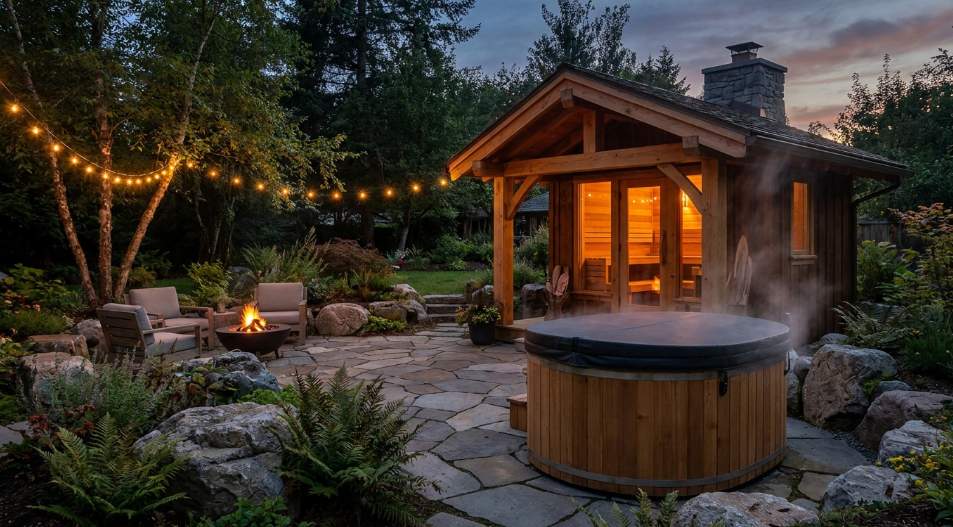
An outdoor sauna built for a genuinely cold winter needs four things a mild-climate model often skips: a heater sized above the standard chart, double-wall insulated construction, a foundation that tolerates freeze-thaw movement, and a roof pitched to shed snow instead of holding it. Skip any one of those and you end up with a cabin that either never gets properly warm or starts shifting and leaking within a couple of hard winters. Here is what actually matters when you are shopping, not just what the brochure photos show.
How Much Heater Capacity Does a Cold Climate Actually Require?
Most heater sizing charts assume a moderate outdoor baseline, somewhere in the 20 to 40 degree range for calculating how much power is needed to bring a given cubic footage up to temperature. In a region where nighttime lows regularly sit in the single digits or below for weeks at a stretch, that baseline chart undersells what the heater actually has to fight. A cabin that a chart rates for a mid-range heater in a temperate zone typically needs the next size class up once you are dealing with a genuinely harsh winter, giving the unit enough reserve capacity to recover heat lost through the walls and door seal without running flat out for the entire session.
What Foundation Holds Up to Freeze-Thaw Movement?
Freeze-thaw heave is a real concern for anything anchored deep into frost-prone soil, but a lightweight cabin sitting on the surface avoids most of that problem entirely. A compacted gravel pad topped with pressure-treated skids is the standard approach for most kit and prefab cabins, since the structure floats on the surface rather than tying into the ground the way a poured foundation would. Concrete deck blocks set on a leveled gravel base work just as well for smaller units. What matters more than the pad material is drainage: grade the site so meltwater runs away from the cabin rather than pooling under it, since standing water refreezing under the skids is what actually causes shifting over a few winters, not the cold itself.
How Thick Does Wall Construction Need to Be for Sub-Zero Nights?
A single-wall cedar cabin looks the part in a catalog photo but bleeds heat fast once the outside air drops well below freezing, forcing longer warm-up times and a heater that never really gets ahead of the loss. Double-wall construction, with insulation packed between an interior and exterior wood layer, holds heat dramatically better and is close to a requirement for anywhere with a real winter. Ask directly whether a model is single or double wall rather than assuming, since it rarely shows up in a photo and some budget cabins cut this corner to hit a lower price point. A proper vapor barrier inside the wall cavity also matters here, since the temperature swing between a hot interior and a frozen exterior wall can otherwise drive condensation into the wood over several seasons.
What Roof Design Actually Sheds Snow Instead of Holding It?
A flat or barely-pitched roof that is fine in a light-snowfall region becomes a genuine structural concern somewhere that regularly sees a foot or more of accumulation. Snow sitting on a low-pitch roof adds real weight the frame needs to be rated for, and meltwater that refreezes at the roofline can work under shingles or panel seams over a few seasons if the pitch cannot shed it fast enough. A steeper pitch, or a metal roof that lets snow slide off on its own, costs a bit more upfront but avoids both the load issue and the slow leak problem that shows up years later, not on delivery day.
Should You Plan for a Windbreak or an Enclosed Entry?
Wind exposure is the variable buyers underestimate most. A cabin sited in the open on a windward slope loses heat every time the door opens, and repeated opening during a session, stepping out to cool off and back in, adds up to a meaningful energy penalty on a genuinely windy night. Positioning the door away from the prevailing wind direction helps at no extra cost. A simple fence panel, hedge, or small covered entry vestibule upwind of the door cuts that heat loss further and makes the walk from house to cabin far more tolerable in a hard freeze.
How Do You Compare Cold-Climate Models Before You Commit?
Wall construction, heater wattage by climate zone, and foundation recommendations are the specs that actually determine whether a cabin holds up through a real winter, not the lifestyle photography most listings lead with. Buyers comparing double-wall against single-wall builds, or sorting out what heater size a given footprint needs in a genuinely cold zone, can check the published specs directly at sweatdecks.com before settling on a size, since that comparison is a faster way to sort real options than guessing from marketing copy that every brand uses regardless of how the cabin is actually built.
Is There Research Behind Regular Sauna Use in Winter?
Beyond the practical build questions, there is a genuine evidence base for sauna use as a habit worth keeping through the colder months. A widely cited Mayo Clinic Proceedings review found regular sauna bathing associated with a range of cardiovascular and general health markers, and a systematic review in Evidence-Based Complementary and Alternative Medicine reported similar associations across a number of smaller studies. These are association findings from cohort data, not controlled proof that sauna use alone changes outcomes, but the pattern holds up consistently enough that a lot of cold-climate owners treat the winter months as the season they use their cabin most, not least.
Frequently Asked Questions
Can an outdoor sauna handle temperatures well below freezing?
Yes, provided the cabin is built for it. Double-wall insulated construction, a heater sized above the standard climate chart, and a sealed door keep a cabin usable even in sustained sub-zero cold.
Does a cold climate mean you need a bigger heater?
Generally yes. Sizing charts are built around a mild baseline, so a cabin rated for a certain heater in a temperate region often needs the next size up in a genuinely hard winter.
What foundation works best for an outdoor sauna in a freeze-thaw climate?
A compacted gravel pad with pressure-treated skids handles most lightweight cabins fine. Good drainage away from the pad matters as much as the pad material itself.
Do outdoor saunas need a windbreak in winter?
It helps considerably on an exposed site. A fence, hedge, or small enclosed entry upwind of the door cuts down on heat lost every time the door opens.
How do you get to an outdoor sauna safely once it snows?
Plan a cleared, non-slip path before winter arrives. A lot of cold-climate sauna injuries come from a slick, unshoveled walkway rather than the heat itself.
References
- “Cardiovascular and Other Health Benefits of Sauna Bathing: A Review of the Evidence.” Mayo Clinic Proceedings, 2018. https://pubmed.ncbi.nlm.nih.gov/30077204/
- “Clinical Effects of Regular Dry Sauna Bathing: A Systematic Review.” Evidence-Based Complementary and Alternative Medicine, 2018. https://pubmed.ncbi.nlm.nih.gov/29849692/
- “Effects of heat and cold on health, with special reference to Finnish sauna bathing.” American Journal of Physiology, 2018. https://pubmed.ncbi.nlm.nih.gov/29351426/